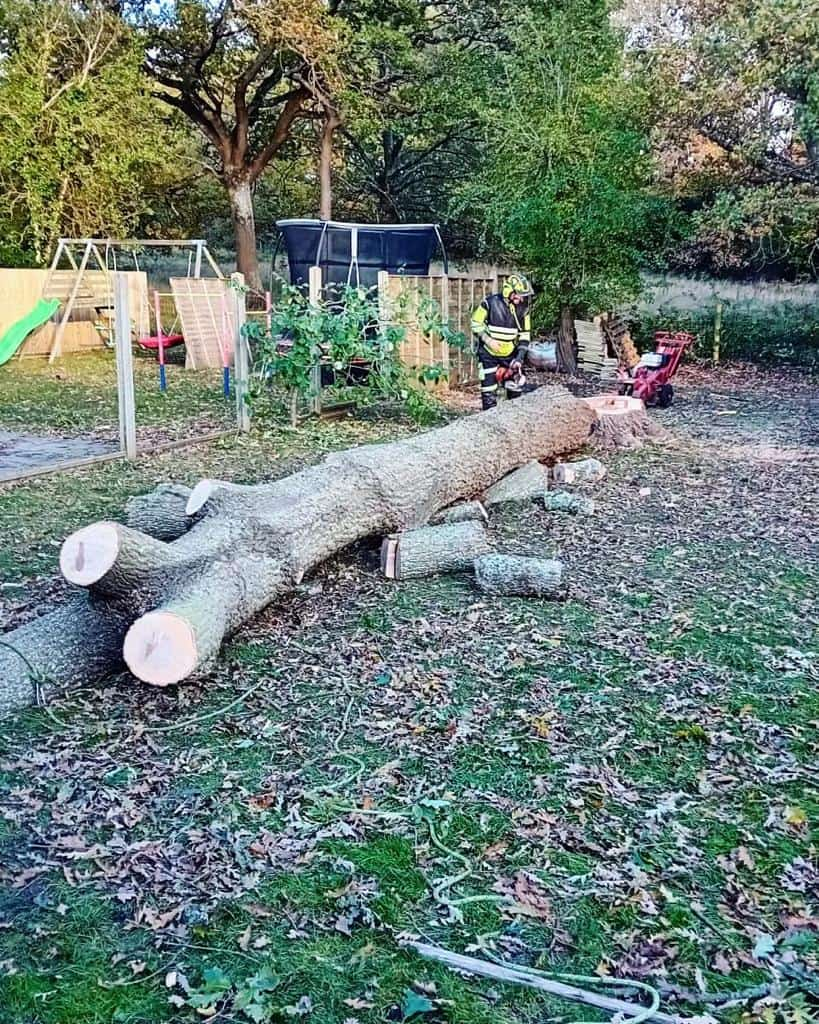
Crown reduction is a professional tree surgery technique used to decrease the overall height, spread or volume of a tree’s canopy. Selected branches are shortened back to suitable growth points, creating a smaller crown while retaining the tree’s natural shape and balanced structure.
For property owners in Banstead, Surrey, crown reduction can help manage a tree that has become too large for its surroundings. The work must be planned carefully because excessive or poorly positioned cuts can damage the tree and create weak future growth.
How Professional Crown Reduction Works
Before any branches are removed, a tree surgeon assesses the tree’s species, health, age, structure and position. This helps determine whether crown reduction is appropriate and how much growth can be removed without placing the tree under unnecessary stress.
The aim is not to cut every branch to the same length. Instead, selected branches are reduced individually, usually back to healthy lateral growth capable of supporting the remaining section. This creates a more natural outline and helps the tree continue developing appropriately.
When Might a Tree Need Crown Reduction?
Crown reduction may be suitable when:
- the canopy has become too large for the available space
- branches are extending towards buildings or garden features
- the tree has developed an unbalanced shape
- excessive growth is creating unwanted shade
- long branches are placing additional strain on unions
- previous damage has left the crown uneven
- the tree needs to remain manageable within its setting
A large tree does not automatically require reduction. Its condition and relationship with the surrounding property are more important than size alone.
Reducing the Size of an Overgrown Canopy
A tree may gradually outgrow the space in which it was planted. Its branches can begin to dominate the garden or extend too close to roofs, windows, paths and boundaries.
Crown reduction can create additional clearance while retaining the tree. The result should appear proportionate, with the branch framework carefully shortened rather than severely cut back.
Improving the Balance of the Tree
Trees do not always develop evenly. Competition for sunlight, nearby structures, weather exposure and previous pruning can encourage more growth on one side of the crown.
Selective reduction can improve weight distribution and produce a more balanced appearance. Where the imbalance is substantial, work may need to be completed gradually to avoid removing too much live material at once.
Managing Heavy or Extended Branches
Long branches can place considerable leverage on their attachment points, particularly when they carry dense foliage. Where a branch is structurally suitable to retain, reducing its length may decrease the load placed on the union.
This does not mean that crown reduction can correct every structural defect. Cracks, decay and weakened branch attachments require individual assessment so the tree surgeon can recommend an appropriate response.
Allowing More Light Into the Garden
Reducing the spread of a large canopy may allow more daylight to reach parts of the garden that have become heavily shaded. However, crown reduction should not be treated as a way to remove an excessive proportion of the tree solely to increase light.
The tree’s health and natural form must remain central to the work. In some cases, carefully selected pruning or crown thinning may be more appropriate.
Crown Reduction Is Different From Crown Thinning
Crown reduction decreases the external dimensions of the canopy. Crown thinning, by comparison, removes selected smaller branches throughout the crown without significantly changing its height or spread.
Crown lifting is another distinct technique that removes or shortens lower branches to create clearance beneath the canopy. A professional assessment establishes which method best addresses the reason for the work.
Why Excessive Cutting Can Harm a Tree
Removing too much foliage reduces the tree’s capacity to produce energy. Large or poorly positioned cuts may also expose internal wood and create potential entry points for decay.
Severe cutting can trigger dense clusters of fast-growing shoots. These may be weakly attached and can make the tree harder to manage in the future. Effective crown reduction uses proportionate cuts and retains sufficient healthy foliage throughout the canopy.
What a Good Crown Reduction Should Achieve
A well-executed crown reduction should:
- create a smaller but naturally shaped canopy
- maintain an even distribution of foliage
- avoid unnecessary large wounds
- preserve suitable branch structure
- provide the required clearance or size reduction
- leave the tree capable of healthy future growth
The finished tree should not appear topped, stripped or abruptly cut. Its overall character should remain recognisable.
Why Professional Assessment Matters
Every tree responds differently to pruning. Species, age, condition and time of year can all affect how much reduction is suitable. Access requirements and the location of surrounding features must also be considered.
A professional tree surgeon can determine whether crown reduction will achieve the intended result or whether selective pruning, thinning, lifting or another approach would be more appropriate.
Conclusion
Crown reduction is the careful shortening of selected branches to reduce a tree’s height, spread or overall canopy volume. It can help manage an overgrown or unbalanced tree, create clearance and reduce the load on extended branches while retaining the tree’s natural form.
The quality of the assessment and pruning is essential to the result. If you are considering crown reduction for a tree in Banstead, Surrey, contact NS Tree Surgery Banstead to arrange a professional assessment and discuss the most suitable approach.
Call us on: 01737 303 494
Click here to find out more about NS Tree Surgery Banstead
Click here to complete our contact form and see how we can help with your trees needs.